- FIN-CLARIAH Research Infrastructure
A new national research infrastructure initiative FIN-CLARIAH for...
8.12.2021 8:12 by eahyvone - WarMemoirSampo published on December 3, 2021
A new “Sampo” application, “WarMemoirSampo”...
8.12.2021 8:04 by eahyvone - Five new SeCo papers accepted for the ISWC 2021
The 20th International Semantic Web Conference (ISWC 2021), the...
2.8.2021 6:53 by eahyvone
- Eljas Oksanen, Frida Ehrnsten, Heikki Rantala and Eero Hyvönen: Semantic Solutions for Democratising Archaeological and Numismatic Data Analysis
- Tomaž Erjavec, Matyáš Kopp, Nikola Ljubešić, Taja Kuzman, Paul Rayson, Petya Osenova, Maciej Ogrodniczuk, Çağrı Çöltekin, Danijel Koržinek, Katja Meden, Jure Skubic, Peter Rupnik, Tommaso Agnoloni, José Aires, Starkaður Barkarson, Roberto Bartolini, Núria Bel, María Calzada Pérez, Roberts Darģis, Sascha Diwersy, Maria Gavriilidou, Ruben van Heusden, Mikel Iruskieta, Neeme Kahusk, Anna Kryvenko, Noémi Ligeti-Nagy, Carmen Magariños, Martin Mölder, Costanza Navarretta, Kiril Simov, Lars Magne Tungland, Jouni Tuominen, John Vidler, Adina Ioana Vladu, Tanja Wissik, Väinö Yrjänäinen and and Darja Fišer: ParlaMint II: Advancing Comparable Parliamentary Corpora Across Europe
- : BD2022 Proceedings of the BD2022 Biographical Data in a Digital World 2022 Conference
- Petri Leskinen and Eero Hyvönen: Biographical and Prosopographical Analyses of Finnish Academic People 1640–1899 Based on Linked Open Data
Vera - Validation and quality assistant for Semantic Web data
Page updated: 11.9.2008
Vera is a generic, browser-based quality checker tool for any RDF data. By quality, we refer to data integrity such as internal linkage, and validity, where the data contents is matched against a closed set of RDF statements in a user defined file written in RDFS and OWL.
The implementation makes use of the general specifications for the standard languages and vocabularies such as RDF, RDFS, OWL, SKOS, DC and FOAF. Also, users can define domain ontologies (eg. MeSH, WordNet) which can be harnessed as trusted resources in the process. The picture below illustrates the relations between different input sources.
The output that Vera produces is not a list of errors per se, but rather a list of possible problems that an expert user can assess and modify the schema or data as needed. The report also contains general statistics about the data, such as language definition usage, so it can also be used for general analysis instead of validation.
This ongoing work is a part of the Semantic Web 2.0 project (FinnONTO 2.0), funded mainly by the National Technology and Innovation Agency (Tekes) and a consortium of 38 private, public and non-governmental organizations.
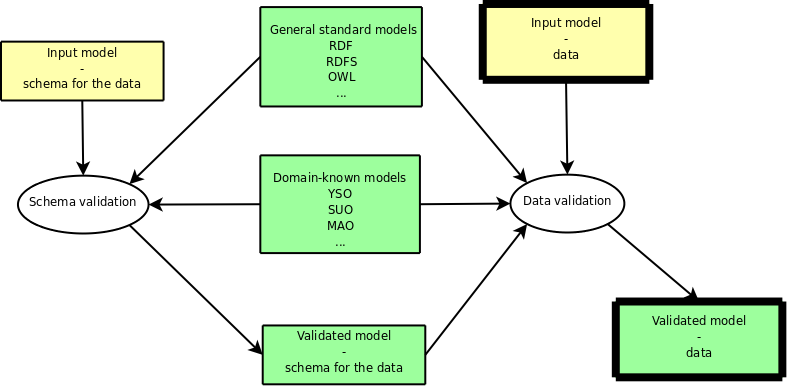
Diagram of the validation process
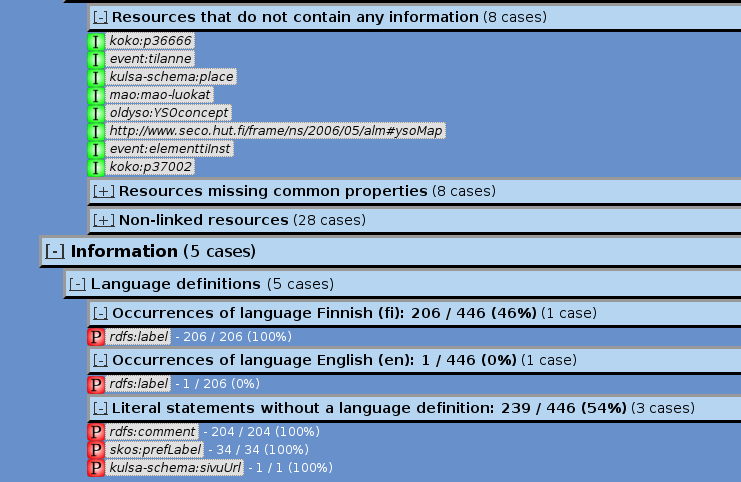
Part of an example report generated by Vera
Design: Olli Alm
Design, Development & Implementation: Joonas Laitio
Contact:
Olli Alm
olli.alm [at] tkk.fi
Prof. Eero Hyvönen
Helsinki University of Technology, Laboratory of Media Technology and University of Helsinki
eero.hyvonen [at] tkk.fi