Finnish Ontology Library Service ONKI
The Finnish Ontology Library Service
ONKI is a pilot
version of a national, centralized ontology library
and related ontology services. The system was created as a part of the
National Semantic Web Ontology Project in Finland (FinnONTO 2003-2012) project by the SeCo group.
Tutustu ONKI-palvelun käyttöönottamisessa opastaviin ohjevideoihin! (Video instructions for integrating ONKI service into your system - only in Finnish.)
ONKI Ontology Library Server
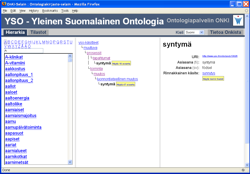
The core component of the ONKI service is its Ontology Library Server ONKI. It
constitutes an important component of the
Finnish semantic web infrastructure developed in the FinnONTO project.
There are three versions of the ONKI server available:
- ONKI SKOS
for lightweight vocabularies in SKOS and ontologies in RDFS/OWL format
- ONKI Geo for geo-ontologies with map support
- ONKI People for representing people and organizations (and similar datasets of individuals)
ONKI Light is a SPARQL-based ONKI server implementation which is currently under development. The purpose of the project is to find out if a SPARQL endpoint can provide enough functionality for the whole ONKI service. See the project's Google Code page for further information.
The Finnish Ontology Library Service ONKI is targeted for three user
groups:
- For an ontology developer, ONKI provides the collaborative
ontology development and versioning environment.
- For a content indexer, ONKI provides a web-based browser
(called ONKI browser) for finding desired concepts and for
transporting the corresponding URI or other data from the ONKI server
into an external application.
- For an information searcher, ONKI browser can be used for
finding and disambiguating keyword meanings, and for transporting the
corresponding URIs into search engines and other applications. For
example, by typing in "bank" the browser finds the different meanings
of the word and shows them to the user.
Integrating ONKI servers to indexing systems using the mash-up approach
The ONKI server can be integrated easily and cost-efficiently to
existing content management systems (CMS) and other indexing
applications using the mash-up approach, which has been
demonstrated in the
ONKI annotation demo. The instructions on how to integrate the
ONKI server to indexing systems can be found on the ONKI Selector Generator
page. See also publications below for more information.
Demonstration Applications
Selected installations of ONKI can be found below for testing:
See the Finnish Ontology Library Service
ONKI
for a variety of ontologies and related services available on the web.
Contact the ONKI Team
Descriptions of ontologies developed at SeCo can be found here.
Articles
2018
Esko Ikkala, Eero Hyvönen and Jouni Tuominen:
Geocoding, Publishing, and Using Historical Places and Old Maps in Linked Data Applications.
Proceedings of the Digital Humanities in the Nordic Countries 3rd Conference, pp. 228-234, CEUR Workshop Proceedings, Vol 2084, Helsinki, Finland, March, 2018.
bib pdf link 2017
2016
Eero Hyvönen, Esko Ikkala and Jouni Tuominen:
Linked Data Brokering Service for Historical Places and Maps.
Proceedings of the 1st Workshop on Humanities in the Semantic Web (WHiSe), pp. 39-52, CEUR Workshop Proceedings, Heraklion, Crete, Greece, May, 2016. Vol 1608.
bib pdf link This paper presents a new Linked Open Data brokering service model HIPLA for using and maintaining historical place gazetteers and maps based on distributed SPARQL endpoints. The model introduces several novelties: First, the service facilitates collaborative maintenance of geo-ontologies and maps in real time as a side effect of annotating contents in legacy cataloging systems. The idea is to support a collaborative ecosystem of curators that creates and maintains data about historical places and maps in a sustainable way. Second, in order to foster understanding of historical places, the places can be provided on both modern and historical maps, and with additional contextual Linked Data attached. Third, since data about historical places is typically maintained by different authorities and in different countries, the service can be used and extended in a federated fashion, by including new distributed SPARQL endpoints (or other web services with a suitable API) into the system. To test and demonstrate the model, we created the first prototype implementation Hipla.fi of the HIPLA model. Hipla.fi is based on four Finnish datasets in SPARQL endpoints totaling some 840,000 geocoded places on 450 historical maps from two atlas series aligned on modern maps, and on the Getty Thesaurus of Geographic Names (TGN) SPARQL endpoint in the US. As a first application, a part of the Hipla.fi data service has been applied in creating a 5 million triple semantic portal of historical Second World War data with tens of thousands of end users.
2015
Eero Hyvönen, Jouni Tuominen, Esko Ikkala and Eetu Mäkelä:
Ontology Services Based on Crowdsourcing: Case National Gazetteer of Historical Places.
Proceedings of the ISWC 2015 Posters & Demonstrations Track, CEUR-WS Proceedings, Bethlehem, PA, USA, October, 2015. Vol 1486.
bib pdf link This paper introduces the idea of applying crowdsourcing to evolving ontology services; the goal is to facilitate collaborative maintenance of ontologies in real time as a side effect of annotating contents in legacy cataloging systems. The idea is being implemented in the use case of creating and managing a national level gazetteer of historical places in Finland.
2014
Osma Suominen, Sini Pessala, Jouni Tuominen, Mikko Lappalainen, Susanna Nykyri, Henri Ylikotila, Matias Frosterus and Eero Hyvönen:
Deploying National Ontology Services: From ONKI to Finto.
Proceedings of the Industry Track at the International Semantic Web Conference 2014, CEUR Workshop Proceedings, Riva del Garda, Italy, October, 2014. Vol 1383.
bib pdf link The Finnish Ontology Library Service ONKI was published as a living laboratory prototype for public use in 2008. Its idea is to support content indexers and ontology developers via a browser interface and machine APIs. ONKI has been well-accepted, but being a prototype maintained by the ending research project FinnONTO (2003–2012), a more sustainable service was needed, supported by permanent governmental funding. To achieve this, ONKI was deployed and is being further developed by the National Library of Finland into a new national vocabulary service Finto. We discuss challenges in the deployment of ONKI into Finto and lessons learned during the transition process.
Eero Hyvönen, Jouni Tuominen, Miika Alonen and Eetu Mäkelä:
Linked Data Finland: A 7-star Model and Platform for Publishing and Re-using Linked Datasets.
The Semantic Web: ESWC 2014 Satellite Events. ESWC 2014 (Presutti, V., Blomqvist, E., Troncy, R., Sack, H., Papadakis, I. and Tordai, A. (eds.)), pp. 226-230, Springer-Verlag, May, 2014.
bib pdf link The idea of Linked Data is to aggregate, harmonize, integrate, enrich, and publish data for re-use on the Web in a cost-efficient way using Semantic Web technologies. We concern two major hindrances for re-using Linked Data: It is often difficult for a re-user to 1) understand the characteristics of the dataset and 2) evaluate the quality the data for the intended purpose. This paper introduces the “Linked Data Finland” platform LDF.fi addressing these issues. We extend the famous 5-star model of Tim Berners-Lee, with the sixth star for providing the dataset with a schema that explains the dataset, and the seventh star for validating the data against the schema. LDF.fi also automates data publishing and provides data curation tools. The first prototype of the platform is available on the web as a service, hosting tens of datasets and supporting several applications.
2013
Matias Frosterus, Jouni Tuominen, Sini Pessala, Katri Seppälä and Eero Hyvönen:
Linked Open Ontology Cloud KOKO--Managing a System of Cross-domain Lightweight Ontologies.
The Semantic Web: ESWC 2013 Satellite Events, pp. 296-297, Springer-Verlag, Berlin Heidelberg, Montpellier, France, May 26-30, 2013.
bib pdf 2012
Kim Viljanen, Jouni Tuominen, Eetu Mäkelä and Eero Hyvönen:
Normalized Access to Ontology Repositories.
Proceedings of the Sixth International Conference on Semantic Computing (IEEE ICSC 2012), IEEE Press, Palermo, Italy, September, 2012.
bib pdf Ontology repositories, such as NCBO Bioportal, ONKI and Cupboard, help finding and using ontologies on the Semantic Web. However, currently each ontology repository constitutes a separate island with its own user interface, APIs, users, ontology languages and set of ontologies. Because there is not a universal way to access all ontology repositories, doing global search, browsing, and inference over all available ontology repositories turns out to be technically difficult and is generally not done. Ontologies are not reused as much as they could and hence the full potential of ontologies is not achieved. To address the problem, we propose the Normalized Ontology Repository (NOR) approach to make the ontology repositories universally accessible while maintaining their unique functionalities and strengths. The SKOS language is used as the lowest common denominator for presenting the ontologies. In addition, a simple API for searching and accessing the ontologies is defined. As a proof-of-concept evaluation, we present three case implementations to demonstrate the NOR approach: 1) the distributed architecture of the ONKI repository, 2) the metasearch for ONKI and NCBO Bioportal, and 3) publishing informal ontological concept collections as NOR end-points, demonstrated with the semantic portal CultureSampo and the metadata editor SAHA.
Jouni Tuominen, Kim Viljanen and Eero Hyvönen:
Ontologiapalvelut semanttisessa webissä (Ontology services on the Semantic Web). (in Finnish), Tietojenkäsittelytiede, no. 34, pp. 17-36, Tietojenkäsittelytieteen Seura ry, April, 2012.
bib pdf Ontologiat ovat keskeinen osa semanttista webiä: ne toimivat yhteisinä jaettuina käsitteistöinä, joiden avulla tietokoneet voivat käsitellä tietoa älykkäämmin. Jotta eri toimijat voivat hyödyntää yhteisiä käsitteistöjä sovelluksissaan, ontologiat on julkaistava heidän käyttöönsä. Yksinkertaisimmillaan ontologiat voidaan julkaista tiedostomuodossa. Tällöin jokainen toimija joutuu toteuttamaan itse toiminnallisuuksia ontologioiden hyödyntämiseen. Koska osa toiminnallisuuksista on yleisiä, useissa järjestelmissä toistuvia, niiden toteuttaminen valmiina palveluina on mielekästä. Palveluita voidaan tarjota ihmiskäyttäjille käyttöliittymäkomponentteina sekä ohjelmalliseen käyttöön rajapintoina, joita käyttämällä toiminnallisuudet voidaan integroida asiakasjärjestelmiin. Tässä artikkelissa kuvataan ontologioiden käyttäjäryhmien tarpeita sekä ontologiapalveluiden toteutuksia. Yleisten ontologioiden käyttämiseen liittyvien toiminnallisuuksien tarjoamiseksi esitetään ontologiapalvelu ONKI, joka on osa Suomalaiset semanttisen webin ontologiat -hankesarjassa (FinnONTO, 2003–2012) kehitettyä ontologiainfrastruktuuria. Artikkeli perustuu Jouni Tuomisen pro gradu -työhön, jolle Tietojenkäsittelytieteen Seura ry myönsi lukuvuoden 2009–2010 pro gradu -palkinnon. Tutkimustyöhön ovat osallistuneet myös Kim Viljanen ja Eero Hyvönen.
2011
Alexander García Castro, Ken Baclawski, John Bateman, Christoph Lange and Kim Viljanen (eds.):
.
Proceedings of the ISWC 2011 Workshop Ontologies Come of Age in the Semantic Web (OCAS), CEUR Workshop Proceedings, Vol 809, http://ceur-ws.org, ISSN 1613-0073, October, 2011.
bib link Kim Viljanen, Jouni Tuominen, Eetu Mäkelä and Eero Hyvönen:
Combining Distributed Ontology Repositories into a Global Service. June, 2011. Draft paper.
bib pdf Ontologies and vocabularies are a key resource for creating interoperable metadata on the Semantic Web. To make finding and using ontologies easier, the idea of Ontology Repositories has been introduced with current implementations including e.g. the NCBO Bioportal, ONKI and Cupboard. There is a genuine need for different kinds of Ontology Repositories, each focusing on different kinds specific user-needs, different ontologies and different organizational requirements which cannot be addressed by a single general implementation. However, at the moment each Ontology Repository is a separate island with its own user interfaces and APIs. They also use varying ontology languages such as OWL, SKOS, and RDF Schema. Due to this, global search, browsing, and inference over the repositories is difficult and generally not done which means that, for example, finding and reusing existing ontologies becomes difficult. To address the problems, we have developed a loosely coupled Network of Ontology Repositories (NOR) architecture that makes the repositories globally interoperable while maintaining their unique functionalities and strengths. To participate in the network, each ontology repository is required to implement a shared API. As a proof-of-concept evaluation, we present three case implementations demonstrating different aspects of the NOR approach: 1) internal distributed architecture of ONKI, 2) global search of ONKI and NCBO Bioportal, 3) publishing non-ontological concept collections as NOR endpoints, demonstrated with the semantic portal CultureSampo and the metadata editor SAHA.
2010
Kim Viljanen, Jouni Tuominen and Eero Hyvönen:
A Network of Ontology Repositories. December, 2010. Draft paper.
bib pdf Ontologies and vocabularies are a key resource for creating interoperable metadata on the Semantic Web. To make the finding and using ontologies easier, the idea of Ontology Repositories have been introduced with current implementations including e.g. the NCBO Bioportal, ONKI and Cupboard. However, at the moment each ontology repository is a separate island with its own user interfaces and APIs. They also use varying ontology languages such as OWL, SKOS, RDF Schema and others. Due to this, global search, browsing, and inference over the repositories is difficult and generally not done. At the same time, there is a genuine need for different kinds of Ontology Repositories, each focusing on different kinds specific user-needs, different ontologies and different organizational requirements which can not be addressed by a single global implementation. Since there are benefits of having interoperability among the repositories, we have developed a loosely coupled Network of Ontology Repository (NOR) architecture that makes the repositories globally interoperable while maintaining their unique functionalities and strengths. To participate in the network, each ontology repository is required to implement a shared API. As a proof-of-concept, we present a global metasearch prototype for searching simultaneously hundreds of ontologies in the ONKI and NCBO Bioportal repositories.
Kim Viljanen, Jouni Tuominen, Mikko Salonoja and Eero Hyvönen:
Global Access to Distributed Ontology Repositories.
Poster Papers, the Extended Semantic Web Conference ESWC 2010, Heraklion, Greece, June, 2010.
bib pdf Ontology repository systems are used for publishing and sharing ontologies. However, currently the repositories form separate islands of ontologies, which hinders the user from finding and utilizing the most suitable ontological concepts and ontologies on a global level. In contrast, this paper presents the idea of creating a network of Linked Open Ontology Services (LOOS) based on a set of ontology services that publish their content via a shared API. This facilitates global search and browsing over all ontologies in the network. LOOS has been implemented in the National Finnish Ontology Service ONKI serving currently 79 ontologies.
Kim Viljanen, Jouni Tuominen, Mikko Salonoja and Eero Hyvönen:
Linked Open Ontology Services.
Workshop on Ontology Repositories and Editors for the Semantic Web (ORES 2010), the Extended Semantic Web Conference ESWC 2010, CEUR Workshop Proceedings, Vol. 596, Heraklion, Greece, June, 2010.
bib pdf link Ontology repository systems are used for publishing and sharing ontologies and vocabularies for content indexing, information retrieval, content integration, and other purposes. However, interlinking these distributed repositories to provide global search and browsing over the repositories has not been made. In the spirit of Linked Open Data, we propose creating a network of Linked Open Ontology Services (LOOS) consisting of ontology repositories that publish their content using a shared API. To test the approach, we have defined an HTTP API and present a proof-of-concept implementation consisting of three client applications that are used for accessing a LOOS network of over 50 ontology servers, part of the Ontology Library Service ONKI.
Jouni Tuominen, Mikko Salonoja, Kim Viljanen and Eero Hyvönen:
A User Interface for Ontology Repositories.
Workshop on Ontology Repositories and Editors for the Semantic Web (ORES 2010), the Extended Semantic Web Conference ESWC 2010, CEUR Workshop Proceedings, Vol. 596, Heraklion, Greece, June, 2010.
bib pdf link Finding ontologies and concepts from a collection of ontologies is a recurring task in many use cases, such as content indexing, searching, and ontology developing. To facilitate this, efficient search and browsing methods are needed. This paper introduces ONKI2, an ontology browser providing a user interface for a repository of ontologies. The system provides a multi-facet search facility for finding an ontology. Finding concepts is supported by autocompletion-based text search that can be refined with additional restrictions. ONKI2 is in use in the Finnish Ontology Library Service ONKI for a collection of 79 ontologies and vocabularies.
Jouni Tuominen:
Helppokytkentäiset ontologiapalvelut semanttisessa webissä. MSc Thesis (in Finnish), University of Helsinki, Department of Computer Science, May, 2010.
bib pdf link Ontologiat luovat semanttisen webin perustan: ne toimivat yhteisinä jaettuina käsitteistöinä, joiden avulla tietokoneet voivat käsitellä tietoa älykkäämmin. Jotta eri toimijat voivat hyödyntää yhteisiä käsitteistöjä sovelluksissaan, ontologiat on julkaistava heidän käyttöönsä. Yksinkertaisimmillaan ontologiat voidaan julkaista datana, tiedostomuodossa. Tällöin jokainen toimija joutuu toteuttamaan itse toiminnallisuuksia ontologioiden hyödyntämiseen. Osa toiminnallisuuksista on yleisiä, useissa järjestelmissä toistuvia, kuten ontologian visualisointi, selaaminen ja käsitehaku. On kuitenkin kustannustehokkaampaa toteuttaa yleisiä ontologiatoiminnallisuuksia valmiina palveluina. Palveluita voidaan tarjota ihmiskäyttäjille käyttöliittymäkomponentteina sekä ohjelmalliseen käyttöön rajapintoina, joita käyttämällä toiminnallisuudet voidaan integroida asiakasjärjestelmiin. Lisäksi käytettäessä ontologioita palveluina toimijoiden käytössä on aina ontologioiden ajantasaiset versiot. Tässä tutkielmassa kuvataan ontologioiden käyttäjäryhmien -- ontologioiden kehittäjien, tiedon annotoijien, tiedon hakijoiden ja semanttisen webin sovellusten kehittäjien -- tarpeita sekä esitellään ontologioiden hyödyntämiseen kehitettyjä sovelluksia. Yleisten ontologioiden käyttämiseen liittyvien toiminnallisuuksien tarjoamiseksi esitetään ontologiapalvelu ONKI, joka julkistettiin virallisesti käyttöön syyskuussa 2008.
2009
Jussi Kurki and Eero Hyvönen:
Authority Control of People and Organizations on the Semantic Web.
Proceedings of the International Conferences on Digital Libraries and the Semantic Web 2009 (ICSD2009), Trento, Italy, September, 2009.
bib pdf Authors and documents with identical titles are common in the digital library environment. In order to manage identities correctly, authority control is used by library and information scientists for disam- biguating and cross-referencing entity names. We argue that the benefits of traditional authority control can be enhanced by using techniques and technologies of the Semantic Web, leading to simpler management of multiple languages, better linkability of resources, simpler reuse of au- thority registries in applications, and less work in indexing. To demon- strate our propositions, we have created a prototype of an ontology server and service called ONKI People that is used in two ways: First, it is a centralized authority service providing human end-users with efficient and easy to use authority finding and disambiguation services based on faceted semantic search and visualizations. The services are available on- line also as AJAX and Web Services API for machines to use. Second, the underlying RDF triple store can be used as a content resource in ap- plications such as semantic cultural heritage portals. The paper discusses and demonstrates both use cases in a real life setting.
Eero Hyvönen, Eetu Mäkelä, Tomi Kauppinen, Olli Alm, Jussi Kurki, Tuukka Ruotsalo, Katri Seppälä, Joeli Takala, Kimmo Puputti, Heini Kuittinen, Kim Viljanen, Jouni Tuominen, Tuomas Palonen, Matias Frosterus, Reetta Sinkkilä, Panu Paakkarinen, Joonas Laitio, Katariina Nyberg:
CultureSampo - A National Publication System of Cultural Heritage on the Semantic Web 2.0.
Proceedings of the 6th European Semantic Web Conference (ESWC2009), Heraklion, Greece, May 31 - June 4, 2009. Springer-Verlag.
bib pdf CULTURESAMPO is an application demonstration of a national level publication system of cultural heritage contents on the Web, based on ideas and technologies of the Semantic (Web and) Web 2.0. On the semantic side, the system presents new solutions to interoperability problems of dealing with multiple ontologies of different domains, and to problems of integrating multiple metadata schemas and cross-domain content into a homogeneous semantic portal. A novelty of the system is to use semantic models based on events and narrative process descriptions for modeling and visualizing cultural phenomena, and for semantic recommendations. On the Web 2.0 side, CULTURESAMPO proposes and demonstrates a content creation process for collaborative, distributed ontology and content development including different memory organizations and citizens. The system provides the cultural heritage contents to end-users in a new way through multiple (nine) thematic perspectives, based on semantic visualizations. Furthermore, CULTURESAMPO services are available for external web-applications to use through semantic AJAX widgets.
Kim Viljanen, Jouni Tuominen and Eero Hyvönen:
Ontology Libraries for Production Use: The Finnish Ontology Library Service ONKI.
Proceedings of the 6th European Semantic Web Conference (ESWC 2009), pp. 781-795, Springer-Verlag, Heraklion, Greece, May 31 - June 4, 2009.
bib pdf This paper discusses problems of creating and using ontology library services in production use. One approach to a solution is presented with an online implementation--the Finnish Ontology Library Service ONKI--that is in pilot use on a national level in Finland. ONKI contributes to previous research on ontology libraries in many ways: First, mashup and web service support with various tools is provided for cost-efficient utilization of ontologies in indexing and search applications. Second, services covering the different phases of the ontology life cycle are provided. Third, the services are provided and used in real world applications on a national scale. Fourth, the ontology framework is being developed by a collaborative effort by organizations representing different application domains, such as health, culture, and business.
Jouni Tuominen, Matias Frosterus, Kim Viljanen and Eero Hyvönen:
ONKI SKOS Server for Publishing and Utilizing SKOS Vocabularies and Ontologies as Services.
Proceedings of the 6th European Semantic Web Conference (ESWC 2009), pp. 768-780, Springer-Verlag, Heraklion, Greece, May 31 - June 4, 2009.
bib pdf Vocabularies are the building blocks of the Semantic Web providing shared terminological resources for content indexing, information retrieval, data exchange, and content integration. Most semantic web applications in practical use are based on lightweight ontologies and, more recently, on the Simple Knowledge Organization System (SKOS) data model being standardized by W3C. Easy and cost-efficient publication, integration, and utilization methods of vocabulary services are therefore highly important for the proliferation of the Semantic Web. This paper presents the ONKI SKOS Server for these tasks. Using ONKI SKOS, a SKOS vocabulary or a lightweight ontology can be published on the web as ready-to-use services in a matter of minutes. The services include not only a browser for human usage, but also Web Service and AJAX interfaces for concept finding, selecting and transporting resources from the ONKI SKOS Server to connected systems. Code generation services for AJAX and Web Service APIs are provided automatically, too. ONKI SKOS services are also used for semantic query expansion in information retrieval tasks. The idea of publishing ontologies as services is analogous to Google Maps. In our case, however, vocabulary services are provided and mashed-up in applications. ONKI SKOS was published in the beginning of 2008 and is to our knowledge the first generic SKOS server of its kind. The system has been used to publish and utilize some 60 vocabularies and ontologies in the National Finnish Ontology Service ONKI www.yso.fi.
Jouni Tuominen, Tomi Kauppinen, Kim Viljanen and Eero Hyvönen:
Ontology-Based Query Expansion Widget for Information Retrieval.
Proceedings of the 5th Workshop on Scripting and Development for the Semantic Web (SFSW 2009), 6th European Semantic Web Conference (ESWC 2009), CEUR Workshop Proceedings, Vol. 449, Heraklion, Greece, May 31 - June 4, 2009.
bib pdf link In this paper we present an ontology-based query expansion widget which utilizes the ontologies published in the ONKI Ontology Service. The widget can be integrated into a web page, e.g. a search system of a museum catalogue, enhancing the page by providing a query expansion functionality. We have tested the system with general, domain-specific and spatio-temporal ontologies.
Eero Hyvönen, Eetu Mäkelä, Tomi Kauppinen, Olli Alm, Jussi Kurki, Tuukka Ruotsalo, Katri Seppälä, Joeli Takala, Kimmo Puputti, Heini Kuittinen, Kim Viljanen, Jouni Tuominen, Tuomas Palonen, Matias Frosterus, Reetta Sinkkilä, Panu Paakkarinen, Joonas Laitio, Katariina Nyberg:
CultureSampo - Finnish Culture on the Semantic Web 2.0. Thematic Perspectives for the End-user.
Proceedings, Museums and the Web 2009, Indianapolis, USA, April 15-18, 2009.
bib pdf We present an overview of CultureSampo, an ambitious system for creating a collective semantic memory of the cultural heritage of a nation on the Semantic Web 2.0, combining ideas underlying the Semantic Web and the Web 2.0. The system addresses the semantic web challenge of aggregating highly heterogeneous, cross-domain cultural heritage collections and other contents into a semantically rich intelligent system for human and machine users. At the same time, CultureSampo is an approach to solve the social and practical Web 2.0 challenge of organizing the underlying collaborative ontology development and content creation work of memory organizations and citizens. This paper focuses on CultureSampo’s search, recommendation, and visualization services for the end-users. The key idea here is to access cultural heritage on the Semantic Web through nine “thematic perspectives”, such as places on the maps, the social network of cultural persons, timelines, and narrative texts, e.g. biographies and literary works.
Eero Hyvönen, Eetu Mäkelä, Tomi Kauppinen, Olli Alm, Jussi Kurki, Tuukka Ruotsalo, Katri Seppälä, Joeli Takala, Kimmo Puputti, Heini Kuittinen, Kim Viljanen, Jouni Tuominen, Tuomas Palonen, Matias Frosterus, Reetta Sinkkilä, Panu Paakkarinen, Joonas Laitio, Katariina Nyberg:
CultureSampo - Finnish Cultural Heritage Collections on the Semantic Web 2.0.
Proceedings of the 1st International Symposium on Digital Humanities for Japanese Arts and Cultures (DH-JAC-2009), Ritsumeikan University, Kyoto, Japan, March, 2009.
bib pdf This paper presents an overview of the SemanticWeb 2.0 application CultureSampo, an ambitious system for creating a collective semantic memory of the cultural heritage of a nation on the Semantic Web 2.0, combining ideas underlying the Semantic Web and the Web 2.0. The system addresses the semantic web challenge of aggregating highly heterogeneous, cross-domain cultural heritage content into a semantically rich intelligent system for human and machine users. At the same time, CultureSampo is an approach to solve the social and practical Web 2.0 challenge of organizing the underlying collaborative ontology development and content creation work of memory organizations and citizens.
Tomi Kauppinen, Heini Kuittinen, Jouni Tuominen, Katri Seppälä and Eero Hyvönen:
Extending an Ontology by Analyzing Annotation Co-occurrences in a Semantic Cultural Heritage Portal.
Proceedings of the ASWC 2008 Workshop on Collective Intelligence (ASWC-CI 2008) organized as a part of the 3rd Asian Semantic Web Conference (ASWC 2008), Bangkok, Thailand, February 2-5, 2009.
bib pdf Ontologies aim to capture knowledge about things and their relationships. Publishing ontologies on the Semantic Web enables people and organizations to use shared ontologies in annotating e.g. photographs, videos, music, and other types of cultural objects. Search engines also use relationships provided by ontologies in semantic search, e.g. for query expansion or for view-based search. However, building ontologies is a time-consuming process, and it should be helped by automatic finding of interesting, possible relationships. Finding the correct concept for annotation purposes is helped by subsumption and partonomy hierarchies and associative relationships. In this paper we show how an analysis of co-occurrences of concepts in annotations can be used to provide interesting relationships for enriching ontological structures. We use association rule mining techniques and test the idea using a set of annotations of cultural objects in CULTURESAMPO portal and the Finnish General Upper Ontology YSO. The results are visualized in the ONKI SKOS browser to give an additional layer on top of the original relationships of the YSO ontology. An analysis shows that best ranked relationships should also be included in the ontology as subclassof or associative relationships.
2008
Eero Hyvönen:
Semanttinen web ja paikkatietoihin perustuvat palvelut (Semantic web and services based on geographical data.
Historiaa kunnioittaen, tulevaisuuteen suunnaten. Maanmittaustieteen päivät 2008, Maanmittaustieteiden Seura, julkaisu n:o 45, ss. 8-16, Espoo, Finland, Nov, 2008.
bib pdf Artikkelissa luodaan katsaus kansallisessa Suomalaiset semanttisen webin ontologiat hankkeessa FinnONTO 2003-2007 ja FinnONTO 2.0 2008-2010 kehitettyihin paikkaontologioihin SUO (Suomalainen paikkaontologia) ja SAPO (Suomen ajallinen paikkaontologia), näiden julkaisemiseen AJAX-palveluina Kansallisessa ontologiapalvelussa ONKI, sekä paikkaontologioiden avulla Kulttuurisampo-portaaliin kehitettyihin palveluhin.
Eero Hyvönen, Kim Viljanen, Jouni Tuominen, Katri Seppälä, Tomi Kauppinen, Matias Frosterus, Reetta Sinkkilä, Jussi Kurki, Olli Alm, Eetu Mäkelä and Joonas Laitio:
National Ontology Infrastructure Service ONKI. Oct 1, 2008.
bib pdf This paper presents the national level cross-domain ontology and ontology service infrastructure ONKI used in Finland. The novelty of ONKI is based on two ideas. First, the core ontologies are developed collaboratively by experts transforming thesauri into mutually aligned lightweight ontologies, based on a large top ontology that is extended by various domain specific ontologies. Second, the National Ontology Service ONKI has been implemented for publishing ontologies cost-efficiently as ready to use services. ONKI provides legacy and other applications with ready to use functionalities for using ontologies on the HTML level by Ajax and semantic widgets. ONKI has been used in various applications for creating mash-up applications in a way analogous to using Google Maps, but in our case external applications are mashed-up with ontology support for indexing and information retrieval.
Eero Hyvönen, Eetu Mäkelä, Tomi Kauppinen, Olli Alm, Jussi Kurki, Tuukka Ruotsalo, Katri Seppälä Kim Viljanen, Jouni Tuominen, Tuomas Palonen, Matias Frosterus, Reetta Sinkkilä, Panu Paakkarinen, Joonas Laitio, Katariina Nyberg:
CultureSampo - A Collective Memory of Finnish Cultural Heritage on the Semantic Web 2.0.
Semantic Computing Research Group, Helsinki University of Technology and University of Helsinki, Sept 29, 2008.
bib pdf This paper presents the Semantic Web 2.0 application CULTURESAMPO, an ambitious system of creating a collective semantic memory of the cultural heritage of a nation on the Semantic Web 2.0, combining ideas underlying the Semantic Web and the Web 2.0. The system addresses the semantic challenge of aggregating highly heterogeneous, cross-domain cultural heritage into a semantically rich intelligent system for human and machine users. At the same time, CULTURESAMPO is an approach to solve the social and practical Web 2.0 challenge of organizing the underlying collaborative ontology development and content creation work of memory organizations and citizens.
Jouni Tuominen, Matias Frosterus, Kim Viljanen and Eero Hyvönen:
ONKI-SKOS - Publishing and Utilizing Thesauri in the Semantic Web.
AI and Machine Consciousness - Proceedings of the 13th Finnish Artificial Intelligence Conference STeP 2008, Espoo, Finland, August 20-22, 2008.
bib pdf Thesauri and other controlled vocabularies act as building blocks of the Semantic Web by providing shared terminology for facilitating information retrieval, data exchange and integration. Representation and publishing methods are needed for utilizing thesauri efficiently, e.g., in content indexing and searching. W3C has provided the Simple Knowledge Organization System (SKOS) data model for expressing concept schemes, such as thesauri. A standard representation format for thesauri eliminates the need for implementing thesaurus specific rules or applications for processing them. However, there do not exist general tools which provide out of the box support for publishing and utilizing SKOS vocabularies in applications, without needing to implement application specific user interfaces for end users. For solving this problem the ONKI-SKOS server is presented.
Jussi Kurki:
Finding People and Organizations on the Semantic Web.
AI and Machine Consciousness - Proceedings of the 13th Finnish Artificial Intelligence Conference STeP 2008, Espoo, Finland, August 20-22, 2008.
bib pdf Finding people is essential in finding information. Librarians and information scientists have studied authority control - psychologists and sociologists social networks. In aforementioned, authors link to documents (and co-authors) creating access points to information. In latter, social paths serve as channels for rumours as well as expertise. Key problems include identification and disambiguation of individuals followed by difficulties of tracking the social connections. With semantic web, these aspects can be approached simultaneously. In this paper, we define a simple ontology for describing people and organizations. The model is based on FOAF and other existing vocabularies. We also demonstrate search and visualization tools for finding people.
Tomi Kauppinen, Riikka Henriksson, Reetta Sinkkilä, Robin Lindroos, Jari Väätäinen and Eero Hyvönen:
Ontology-based Disambiguation of Spatiotemporal Locations.
Proceedings of the 1st international workshop on Identity and Reference on the Semantic Web (IRSW2008), 5th European Semantic Web Conference 2008 (ESWC 2008), CEUR Workshop Proceedings, ISSN 1613-0073, June 1-5, 2008.
bib pdf Geographic place names are semantically often highly ambiguous. For example, there are 491 places in Finland sharing the same name ”Isosaari” (great island) that are instances of several geographical classes, such as Island, Forest, Peninsula, Inhabited area, etc. Referencing unambiguously to a particular ”Isosaari”, either when annotating content or during information retrieval, can be quite problematic and requires usage of advanced search methods and maps for semantic disambiguation. Historical places introduce even more challenges, since historical metadata commonly make spatiotemporal references to historical regions and places using names whose meanings are non-existing or different in different times. This paper presents how these problems have been addressed in a large Finnish place ontology SUO and a historical geo-ontology SAPO. A location ontology server ONKI-Geo has been created for publishing the ontologies and utilizing them as mashup services. To demonstrate the usability of our ontologies, two case applications in the cultural heritage domain are presented.
Kim Viljanen, Jouni Tuominen and Eero Hyvönen:
Publishing and Using Ontologies as Mash-Up Services.
Proceedings of the 4th Workshop on Scripting for the Semantic Web (SFSW2008), 5th European Semantic Web Conference 2008 (ESWC 2008), CEUR Workshop Proceedings, Vol. 368, Tenerife, Spain, June 1-5, 2008.
bib pdf link The Semantic Web is based on using ontologies for enabling semantically disambiguated data exchange between distributed systems on the web. This requires efficient means for publishing ontologies on the web to ensure the availability, sharing and acceptance of the ontologies. Support services are needed for utilizing ontologies easily and cost-effectively in applications and legacy systems lacking ontology support. To address these vital needs, this paper presents the ONKI ontology service which provides ready-to-use mash-up functionalities, such as semantic disambiguation, concept finding and concept fetching as ready-to-use web widgets for adding ontology support to e.g. HTML forms using JavaScript. Two implementations of the ONKI Server are presented: ONKI-SKOS for ontologies presented in the Simple Knowledge Organization System (SKOS) language and ONKI-Geo for geographical ontologies with a map interface. The presented ONKI systems are operational on the web, used in the National Finnish Ontology Service. They have been successfully used in several pilot applications.
Eero Hyvönen, Kim Viljanen, Jouni Tuominen and Katri Seppälä:
Building a National Semantic Web Ontology and Ontology Service Infrastructure - The FinnONTO Approach.
Proceedings of the European Semantic Web Conference ESWC 2008, pp. 95-109, Springer, Tenerife, Spain, June, 2008.
bib pdf This article presents the vision and results of creating a national level cross-domain ontology service infrastructure in Finland in the FinnONTO project. The novelty of the infrastructure is based on two ideas. First, a system of open source core ontologies is being developed by transforming thesauri into mutually aligned lightweight ontologies, including a top ontology of 20,000 concepts that is extended by various domain specific ontologies. Second, the ONKI Ontology Server framework for publishing ontologies as ready to use services has been designed and implemented. ONKI provides legacy and other applications with ready to use functionalities for using ontologies on the user interface level as semantic widgets. The idea is to use ONKI for creating mash-up applications in a way analogous to using Google or Yahoo Maps, but in our case external applications are mashed-up with ontology support. The ontology framework presented is operational on the web and is being used in creating the application demonstrations.
Robin Lindroos:
Paikkatiedon ontologiapalvelu. MSc Thesis, Helsinki University of Technology (TKK), May, 2008.
bib pdf Tämä diplomityö käsittelee menetelmiä, joilla paikkatietoaineistoja muunnetaan ontologiseen muotoon sekä esittelee palvelun, ONKI-Paikan, jolla ontologisessa muodossa olevaa paikkatietoa voidaan tuottaa, ylläpitää ja hakea. Palvelu perustuu paikkatiedon mallintamiseen Suomalaisen paikkaontologian SUO:n mukaisesti. Työ koostuu neljästä vaiheesta. Ensimmäisessä vaiheessa selvitetään menetelmä, jolla SUO-ontologia populoidaan paikkainstansseilla. Erityistä huomiota kiinnitetään paikkojen uniikkien tunnisteiden, URI:en luomiseen. Toisessa vaiheessa selvitetään, miten ontologian populointivaiheessa tuotetut paikkojen RDF-kuvaukset on tallennettava. Kolmannessa vaiheessa ratkotaan ontologisessa muodossa olevan paikkatietoaineiston suuren määrän tuomia ongelmia muun muassa kehittämällä paikkatiedon RDF-varastolle indeksointitietokanta nopeita hakuja varten. Neljännessä vaiheessa kehitetään rajapinta hakujen suorittamista varten sekä hakurajapintaa hyödyntävä graafinen, selaimessa toimiva käyttöliittymä. Työ on tehty osana FinnONTO-projektia, jossa kehitettiin suomalaisiin olosuhteisiin räätälöityjä semanttisen webin ontologioita sekä näitä hyödyntäviä palveluita.
Riikka Henriksson, Tomi Kauppinen and Eero Hyvönen:
Core Geographical Concepts: Case Finnish Geo-Ontology. Location and the Web (LocWeb) 2008 workshop, 17th International World Wide Web Conference WWW 2008, ACM International Conference Proceeding Series; Vol. 300, Pages 57-60, Beijing, China, April 21-25, 2008.
bib pdf In this paper we examine 1) the scope of geo-ontologies used especially for the purposes of information retrieval on the Web, 2) the core geographical concepts and their mutual relations, and 3) the properties the concepts have. Furthermore, we present the Finnish geo-ontology (Suomalainen paikkaontologia, SUO) and discuss the theories and principles that have governed the development process, as well as the limitations and requirements the use of geographical dictionaries as an instance data source have imposed to the content and the structure of SUO.
Kim Viljanen, Jouni Tuominen, Teppo Känsälä and Eero Hyvönen:
Distributed Semantic Content Creation and Publication for Cultural Heritage Legacy Systems.
Proceedings of the 2008 IEEE International Conference on Distributed Human-Machine Systems, IEEE Press, Athens, Greece, March 9-12, 2008.
bib pdf Cultural heritage is by nature strongly interlinked, e.g. thematically and historically, but at the same time distributed in heterogeneous collections of different memory organizations at different locations. In order to provide the end-users with aggregated homogeneous views to distributed heterogeneous contents, semantic portals have been created successfully based on metadata and shared (or aligned) ontologies. This paper discusses two problems encountered in such a distributed semantic content creation environment. First, during the content creation work, how could a publisher start using shared ontologies in legacy cataloguing and annotation systems that do not support ontologies. Second, during content publication, how could a publisher re-use the aggregated content in its own legacy publication system, e.g., on the ordinary web pages of a museum or in a collection browser. As a solution, we present the ONKI Ontology Server for adding shared ontological annotation functionalities to legacy cataloguing systems in a practical, cost-efficient and lightweight way. For distributed publishing of the aggregated semantic portal services, we introduce the lightweight mash-up web widget components called floatlets . A major idea behind both the ONKI functionalities and floatlets is that they can be easily integrated with legacy systems on the user interface level, in the same spirit as e.g. Google Maps.
2007
Eetu Mäkelä, Kim Viljanen, Olli Alm, Jouni Tuominen, Onni Valkeapää, Tomi Kauppinen, Jussi Kurki, Reetta Sinkkilä, Teppo Känsälä, Robin Lindroos, Osma Suominen, Tuukka Ruotsalo and Eero Hyvönen:
Enabling the Semantic Web with Ready-to-Use Web Widgets.
Proceedings of the First Industrial Results of Semantic Technologies Workshop, ISWC2007, pp. 56-69, CEUR Workshop Proceedings, Vol. 293, November 11, 2007.
bib pdf link A lot of functionality is needed when an application, such as a museum cataloguing system, is extended with semantic capabilities, for example ontological indexing functionality or multi-facet search. To avoid duplicate work and to enable easy and cost-efficient integration of information systems with the Semantic Web, we propose a web widget approach. Here, data sources are combined with functionality into readyto-use software components that allow adding semantic functionality to systems with just a few lines of code. As a proof of the concept, we present a collection of general semantic web widgets and case applications that use them, such as the ontology server ONKI, the annotation editor SAHA and the culture portal CultureSampo.
Kim Viljanen, Jouni Tuominen, Eero Hyvönen, Eetu Mäkelä and Osma Suominen:
Extending Content Management Systems with Ontological Annotation Capabilities.
Poster proceedings of the 6th International Semantic Web Conference, Busan, Korea, November 11-15, 2007.
bib pdf Producing semantic metadata requires efficient methods, e.g., concept finding, for accessing and using ontologies. To add such functionalities to metadata applications such as cataloging systems in museums, we propose a \emphmash-up approach where ready-to-use user interface components for using specific ontologies are made available to be integrated into applications. As a proof-of-concept, we present the \emphOntology Service ONKI wich implements semantic autocompletion concept search and concept browsing for ontologies as shared mash-up components.
Kim Viljanen, Jouni Tuominen and Eero Hyvönen:
ONKI Ontology Server--Extending Legacy Systems with Ontology Mash-up Services. November, 2007. Draft paper.
bib pdf The Semantic Web is based on using shared ontologies for enabling semantically disambiguated data exchange between distributed systems on the web. This requires, from the ontology publisher s viewpoint, efficient means for publishing ontologies on the web to ensure the availability and acceptance of the ontologies. From the ontology user s viewpoint, support services are needed for utilizing ontologies easily and cost-effectively in the users own systems that are typically legacy systems without ontology support. This paper presents the ONKI ontology server for addressing these vital needs. For the publisher, ONKI provides a server and a Simple Knowledge Organization (SKOS) compatible light-weight ontology browser with ready-made web interfaces for making ontologies available both for human and machine users. For external legacy and other applications, ONKI provides centralized ontology services for semantic disambiguation, concept finding, and concept fetching. A major contribution of ONKI is to provide these services as ready-to-use functionalities for creating mash-up applications very cost-efficiently. Two prototypes of the system---ONKI-SKOS for all kinds of ontologies and ONKI-Geo for geographical ontologies with a map mash-up interface---are operational on the web and are currently being successfully used in several pilot applications.
Eero Hyvönen, Kim Viljanen and Osma Suominen:
HealthFinland - Finnish Health Information on the Semantic Web.
Proceedings of the 6th International Semantic Web Conference (ISWC 2007), Busan , Korea, Springer-Verlag, Nov, 2007.
bib pdf This paper shows how semantic web techniques can be applied to solving problems of distributed content creation, discovery, linking, aggregation, and reuse in health information portals, both from end-users and content publishers viewpoints. As a case study, the national semantic health portal \HF\ is presented. It provides citizens with intelligent searching and browsing services to reliable and up-to-date health information created by various health organizations in Finland. The system is based on a shared semantic metadata schema, ontologies, and ontology services. The content includes metadata about thousands of web documents such as web pages, articles, reports, campaign information, news, services, and other information related to health.
Eero Hyvönen, Robin Lindroos, Tomi Kauppinen and Riikka Henriksson:
An ontology service for geographical content.
Poster Proceedings of the International Semantic Web Conference (ISWC 2007), Busan, Korea, Nov, 2007.
bib pdf Geographic place names are widely used but are semantically often highly ambiguous. For example, there are 491 places in Finland sharing the same name Isosaari (great island) that are instances of several geographical classes, such as Island, Forest, Peninsula, Inhabited area, etc. Referencing unambiguously to a particular Isosaari , either when annotating content or during information retrieval, can be quite problematic and requires usage of advanced search methods and maps for semantic disambiguation. This paper presents an ontology server, ONKI-Paikka, for solving the place finding and place name disambiguation problem. In ONKI-Paikka, places can be found by a faceted search engine, combined with semantic autocompletion and a map service for constraining search and for visualizing results. The service can be connected to legacy applications cost-effectively by using Ajax-technology in the same spirit as Google Maps that is used in ONKI-Paikka as a subservice.
Eero Hyvönen, Kim Viljanen, Eetu Mäkelä, Tomi Kauppinen, Tuukka Ruotsalo, Onni Valkeapää, Katri Seppälä, Osma Suominen, Olli Alm, Robin Lindroos, Teppo Känsälä, Riikka Henriksson, Matias Frosterus, Jouni Tuominen, Reetta Sinkkilä and Jussi Kurki:
Elements of a National Semantic Web Infrastructure - Case Study Finland on the Semantic Web (Invited paper).
Proceedings of the First International Semantic Computing Conference (IEEE ICSC 2007), Irvine, California, September, 2007. IEEE Press.
bib pdf This article presents the vision and results of creating the basis for a national semantic web content infrastructure in Finland in 2003-2007. The main elements of the infrastructure are shared and open metadata schemas, core ontologies, and public ontology services. Several practical applications testing and demonstrating the usefulness of the infrastructure are overviewed in the fields of eCulture, eHealth, eGovernment, eLearning, and eCommerce.
Kim Viljanen, Eero Hyvönen, Eetu Mäkelä, Osma Suominen and Jouni Tuominen:
Mash-up Ontology Services for the Semantic Web. Demo track at the European Semantic Web Conference ESWC 2007, Innsbruck, Austria, June 4-5, 2007.
bib pdf We present ONKI ontology server, a mash-up approach for integrating ontology library services with semantic web applications. The idea of ONKI is to provide applications with ready-to-use ontology service functionalities, such as semantic autocompletion, browsing, and annotation support, at the user interface level using AJAX mash-up technologies. The system is being integrated with various semantic web applications.
2005
in Finnish:
ONKI - Kansallinen ontologiakirjastopalvelin
Täkeimpänä ontologiapalveluiden kehityskohteena FinnONTO-projektissa on
kansallinen ontologiakirjasto ja -palvelin ONKI.
ONKI tarjoaa palveluja kolmelle käyttäjäryhmälle:
- Ontologian kehittäjät saavat työvälineen hajautetun
ontologiakehityksen koordinoimiseksi ja tueksi. Järjestelmän avulla
eri sanastoja kehittävät työryhmät voivat ottaa käyttöönsä toistensa
määrittelemiä käsitteitä, hallita ontologioiden versiointia, pysyä
ajan tasalla toisten ontologioiden muutoksista jne.
- Tiedon indeksoijalle on tarjolla selainperustainen web-palvelu,
jolla sisällönkuvailussa tarvittava käsite voidaan vaivattomasti
löytää ja siirtää web-palvelun kautta ulkoiseen sovellukseen,
esimerkiksi museon luettelointijärjestelmään.
- Tiedon hakijalle on tarjolla edellisen kaltainen
selainperustainen palvelu, jolla voidaan helposti muodostaa
ontologiaperustaisia kyselyjä. Näin voidaan esimerkiksi erottaa
hakusanan "Nokia" merkitys yrityksenä ja kuntana tai se, onko
"johtamisessa" kyse yrityksen, sähkön, kaavan, vai musiikin
johtamisesta. Edelleen voidaan löytää johtamista käsittelevät
dokumentit (web-sivut), vaikka niissä puhuttaisiin johtamisesta eri
sanoin tai eri kielillä.
(Katso demo-sovellus.)